
Royal Decree-law 29/2026 of 6 October is this year's most important housing measure and it directly affects owners of tourist apartments and seasonal lets: it brings in 10% VAT on certain short stays, lets councils add an IBI surcharge and tightens the rules on temporary and room rentals. Here is what matters, with links to each topic.
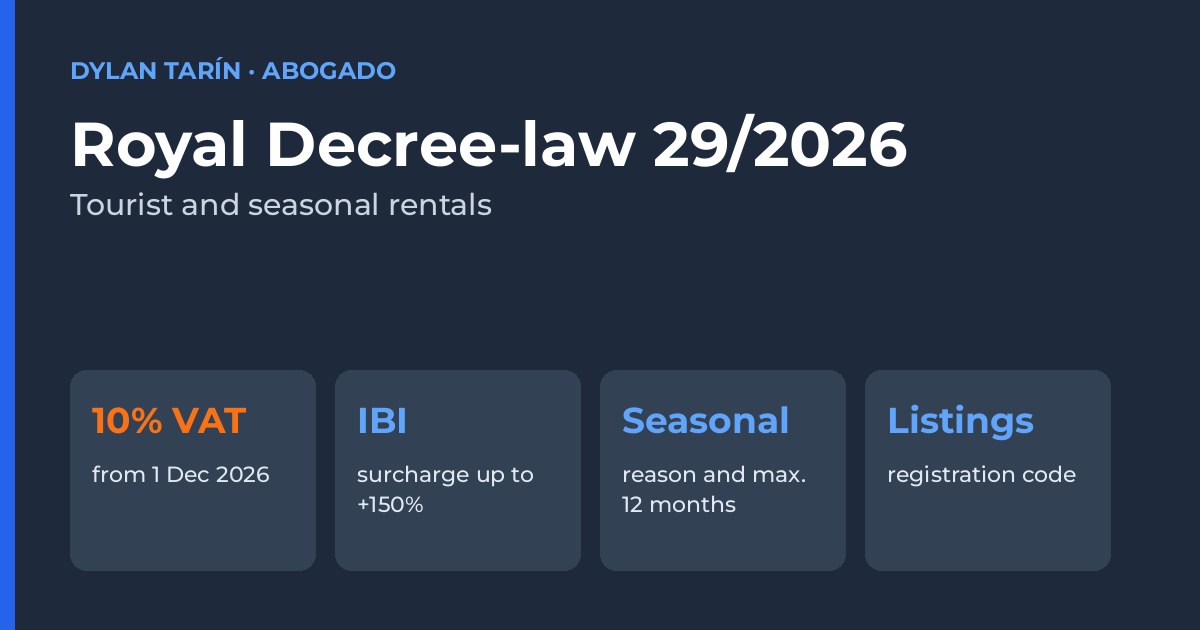
Quick summary
- In force since 8 October 2026 (published in the BOE on 7 October) and validated on 12 November by the Standing Committee of the Congress of Deputies.
- 10% VAT from 1 December 2026 on furnished lets of up to 30 nights that are not the landlord's main home.
- IBI: optional surcharge of up to 50% (100% with two or more properties, 150% with four or more) in tight-market areas, if the council approves it.
- Seasonal lets: a real, provable reason, more than 31 days and, as a rule, up to 12 months.
- Listings: must show the identification number or code where one exists, such as the regional tourist-home code.
10% VAT from 1 December 2026
Article 7 amends the VAT Act. According to its text, lets of furnished apartments or homes lose the exemption where the landlord provides hotel-type services, or where a stay of no more than thirty nights and accommodation that is not the landlord's main home occur together. Those lets move to the reduced 10% rate. Both changes take effect from 1 December 2026.
In practice, many tourist-apartment owners will have to charge VAT on bookings and meet the related filing obligations. How this fits with invoicing, input VAT or each owner's situation should be reviewed with a tax adviser before that date.
IBI surcharge on tourist accommodation
Article 8 allows councils in tight residential market areas to add a surcharge to the IBI property tax on residential properties used as tourist accommodation: up to 50% of the tax due, up to 100% for owners of two or more properties with that use and up to 150% for owners of four or more.
The surcharge is not automatic: each council must approve it through a local tax ordinance. Barcelona is among the Catalan municipalities declared a tight-market area, so it is worth following what the City Council approves.
Seasonal and room rentals
Article 3 amends the Urban Leases Act to stop seasonal lets from masking permanent housing needs. According to the text, a temporary let requires a real, provable reason, a term of more than 31 days and, as a general rule, no more than 12 months. If it exceeds that without justification, or more than two consecutive contracts are chained between the same parties for the same home, it is treated as a main-residence let from the first one. A temporary contract with no stated reason is also treated as a main-residence let.
For room rentals, the rents added together cannot exceed the rent the whole-home contract would have, with extra limits in tight-market areas. Regional rules on these contracts still apply, and Catalonia has its own. More detail in our seasonal rental guide.
Listings, platforms and registry
Article 20 requires advertising for a let to include the home's identification number, code or title where one exists, such as the regional or municipal codes for tourist homes. The decree also provides mechanisms for platforms to meet their information and data-sharing duties with the Digital Single Window for Rentals, with its penalty regime, in line with Regulation (EU) 2024/1028.
Do not confuse this with the state single registry (NRUA): the Supreme Court annulled that procedure in May 2026, and the number that still counts in listings is that of your region's tourist register. We explain it in the single registry guide.
What to do now
- Check which bookings of up to 30 nights are affected by VAT from 1 December, and adjust prices and invoicing.
- If you use seasonal contracts, check the documented reason, the term and the chain of contracts with the same tenant.
- Make sure your listings show the correct regional registration code.
- Follow your municipality's tax ordinances in case it approves the IBI surcharge.
- If your licence is in Barcelona, keep the 2028 timeline in mind (end of licences).
Related guides
Frequently asked questions
When does 10% VAT apply to tourist rentals?
Under Royal Decree-law 29/2026, the VAT Act change takes effect from 1 December 2026. It affects furnished lets of up to 30 nights that are not the landlord's main home.
Is the decree final?
It was validated by the Standing Committee of the Congress of Deputies on 12 November 2026 and the resolution was published in the BOE on 13 November, so it no longer lapses. It can still be amended later by a law.
Will my council apply the IBI surcharge?
It is not automatic. The decree only allows it in tight residential market areas and each council must approve it through a local tax ordinance.
Are 11-month seasonal contracts still valid?
Only if there is a real, provable reason for the temporary use, they are in writing and no more than two contracts are chained with the same tenant. With no stated reason, they are treated as main-residence lets. Each contract should be reviewed.
Is the state single registry still required?
No. The Supreme Court annulled that procedure in May 2026. Listings must show the relevant identification code, such as the regional one for tourist homes.
Does it affect the end of Barcelona's licences in 2028?
It does not change that timeline, which depends on Decree-Law 3/2023 and the municipal decision not to renew. It does add tax obligations while you keep operating.